

HAMSTRING INJURY PREVENTION
Hamstring injuries are one of the most common sporting injuries, accounting for 10–26% of all acute injuries, and have one of the highest total time loss injuries across all sports due to high recurrence rates.
What are they? How do they happen? And what can be done this off-season to reduce your risk of a hamstring injury in the upcoming season?

The hamstring muscle group consists of 4 muscles, medially semitendinosus and semimembranosus and laterally biceps femoris long and short head, which accounts for 70–84% of all hamstring injuries.
Injuries can range from mild to severe and time to return to sport will depend on the severity of your injury and whether the injury is to the muscle or tendon.
Grade 1: 7–14 days (1–2 weeks)
Grade 2: 14–35 days (3–6 weeks)
Grade 3: 42–>84 days (6 weeks–4+ months) - complete ruptures/ tendon avulsions require surgery, with RTP up to 6 months.
MECHANISM:
Sprinting is one of the most common ways to injure the hamstring, especially in the late swing phase, when there are intense eccentric contractions at long muscle lengths (especially Biceps Femoris long head).
Stretch-type injuries occur due to extensive hip flexion with simultaneous knee extension, which can occur at the end of a kick, picking up a ball from the ground while running or when falling/ tackling. In AFL 19% of hamstring injuries occur during kicking.
Risk factors:
Previous hamstring injury - In professional soccer the rate is 18% of injuries are recurrent, 69% are within 2 months of RTP and in AFL reinjury rate is 26–34%, with more than 50% within 2 months.
Strength and Flexibility deficits - flexibility of hamstring and hip flexors as well as the eccentric hamstring strength (symmetry and age-related norms)
Spike in workload - reduced match exposure in the two previous games increased risk in the following match.
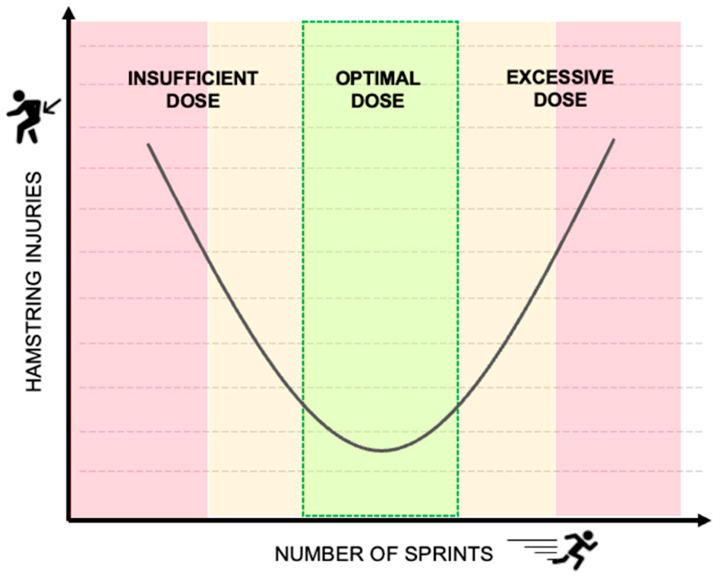
High speed running - either too little or too much.
Running technique - excessive anterior pelvic tilt, delayed hip extension, or increased ground contact time.
Age - beyond 23-25 years old risk of injury increases by 1.3-1.78x each year.
Fatigue.
PREVENTION:
The best way to prevent hamstring injuries will vary from person to person based on their own risk profile and chosen sport. Completing an ATHLETE SCREEN will look at previous injury history, provide insights into strength and flexibility, and create a personalised training program based on the data.
Sprinting >90% max speed at least 1x per week (>48hrs before competition/ between sessions), will build sprint-specific adaptations and help achieve an optimal dose of sprint exposure to minimise risk in competition. Intensity is important as increasing sprint speed from 80-100% increases the activation of the hamstring muscles between 37-67%. While the best hamstring exercises achieve <60% of the activation at the hamstrings when compared to sprints.
Maximal eccentric strengthening exercises, such as the Nordic Hamstring Curl, have been shown to reduce the rate of hamstring injuries by >50% in all field sports. These exercises also allow specific overload during the eccentric phase, which is when hamstring injuries are most likely to occur when sprinting.

Emphasis on structured preseason conditioning to increase workload progressively and avoiding spikes in volume/ intensity at the start of the season. Avoiding sudden spikes in Acute (weekly) vs Chronic (monthly) workload which can come from fixture congestion in season or from a period of reduced exposure (such as a holiday or reduced game-time), this can be managed by reading training volume during busy periods or adding in top up runs when game time is reduced.
Final thoughts:
Hamstring injuries are complex and multi-factorial, addressing the risk factors most relevant to you will help you to minimise your risk of injury however if you’re unlucky enough to sustain a hamstring injury booking in a physiotherapy session will help to get you back up and running in no time.