PLAGIOCEPHALY UPDATE 2026
Flat heads, cute babies, calm physios and why everyone’s algorithm needs to relax
Back in 2020 we wrote about plagiocephaly for our very first blog! So we felt an update was in order. Jokes on the social media team: it’s 2026 and the situation is largely unchanged. End of story. Cheers. Thanks for coming to our blog. Bye bye…
…Just kidding! For real we are doing an update so here it is
Refresher:
Babies are still born with beautifully squishable skulls
Parents are still noticing flat spots
The internet is still suggesting dramatic interventions
And paediatric physios are still saying, “can we all just take a breath?”
What is plagiocephaly?
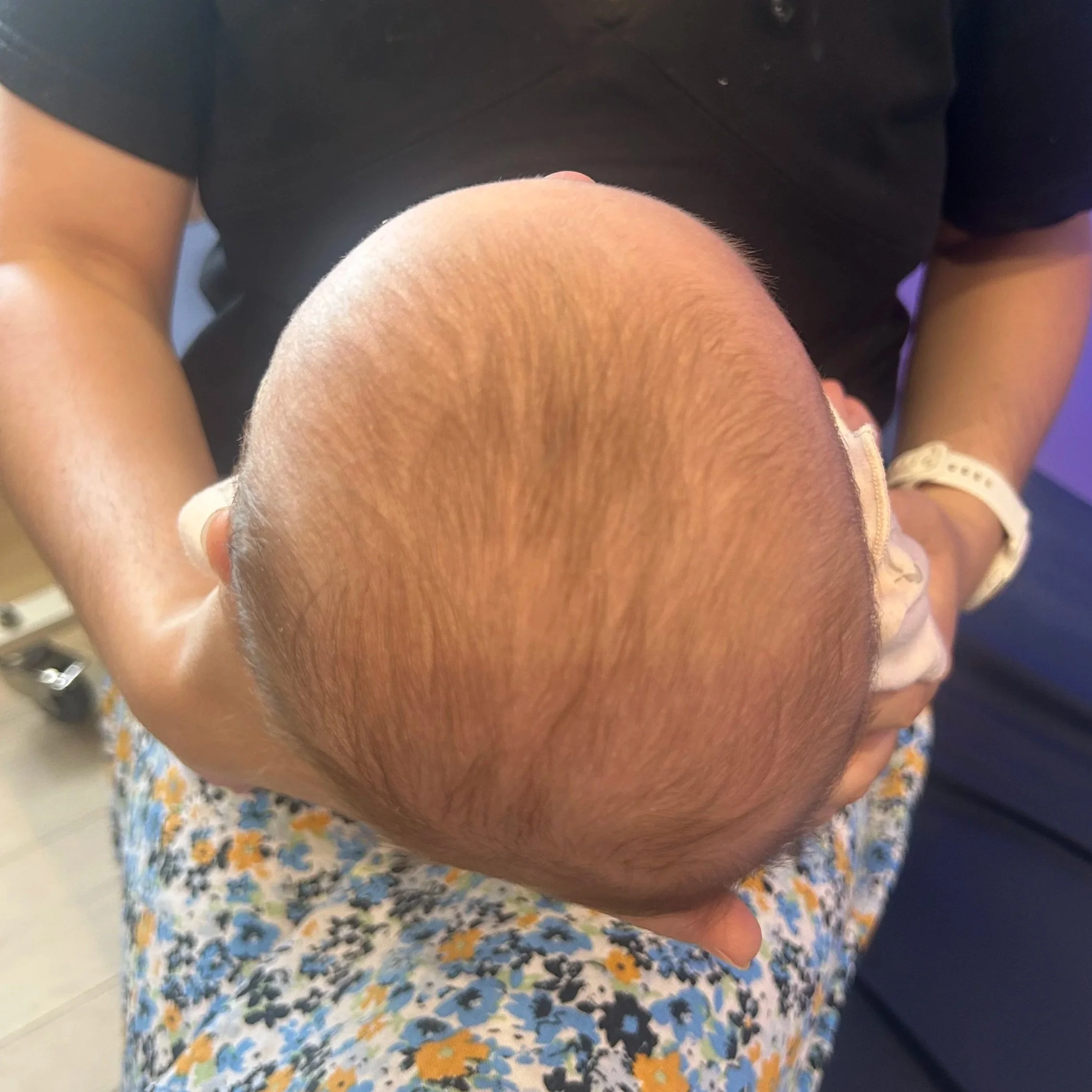
Plagiocephaly is a change in head shape caused by pressure on one area of a baby’s soft skull while they lie down. It can occur when one side of the head is favoured over the other with repeated pressure causing the preferred side to begin to flatten out. It can also be caused by a condition known as torticollis where neck muscles are very tight and stop a baby being able to turn their head to the other side.
In both instances the baby’s head shape becomes flat on one spot and begins to push the corresponding front of head forwards, giving the head a parallelogram-like shape which is where the word plagiocephaly comes from.
(Note: another head shape condition commonly seen is brachycephaly, when a baby has a symmetrical flattening at the back of the head rather than the side)
What causes Plagiocephaly?
There can be many factors causing a baby to develop plagiocephaly but is most often attributed to:
Babies sleeping on their backs due to SIDS safe sleep practices (lots of time to put pressure on the back of the skull)
Babies preferring to look in one direction
Difficulty turning/looking to the opposite side
Time spent in ‘containers’ which can limit head movement, eg, capsules / swings / carriers / etc
Tight neck muscles (torticollis) causing them to be stuck on one side
Signs of plagiocephaly
From above, the head may look:
Slightly flattened
Uneven at the back
Parallelogram-shaped
May have a bald patch
May have a raised section on forehead of flat side
Ear may look uneven
Face may start to become asymmetrical
Why are physios so calm about plagiocephaly?
Let’s make the most important statement early: Plagiocephaly is cosmetic. It does NOT affect brain development. Your baby is not becoming less intelligent because of a flat spot.
We see this commonly and most babies improve when they:
Gain head control
Start to roll
Sit and offload the head
Crawl and mobilize
Stop being adorable play mat potatoes
Growth + movement + offload = natural reshaping
A moment for torticollis
Torticollis is a real troublemaker. It is a condition causing tightening of neck muscles that then restricts movement of the neck in rotation and side flexion. At first, it may be unclear if a baby has a simple plagiocephaly or it is a secondary effect to torticollis.
A baby may have:
Plagiocephaly ONLY (positional plagiocephaly)
Torticollis ONLY (tightness of neck and preference to one side of head)
Plagiocephaly AND torticollis (the real overachiever - tight neck to one side which over time then impacts the headshape)
Torticollis or torticollis + plagiocephaly babies may:
Strongly prefer turning one way and possibly unable to look to the other way
Combination of rotation and tilt of head from muscle tightness
Struggle with tummy time
Develop plagiocephaly because pressure is repeated in one area
If torticollis is present: Head shape will not improve until neck movement improves.
How does physiotherapy help?
Gentle stretching of tight muscles
Strengthening of the opposite side muscles
Positioning strategies
Motor development support
Treat the neck → head shape often follows
Update 1: The rise of structured measurements
This may be our “we told you so moment” because objective measurement has always been our thing (hello data queens). We were measuring baby heads before it was cool and systematic reviews told us we should because we love data! We trust graphs more than vibes and we feel our parents love knowing the maths behind these little cutie heads, where they’ve come from and how much change they’ve made.
So yes, we are thrilled everyone else has finally joined the spreadsheet party because research updates have solidly supported objective measurement use in diagnosis and management of plagiocephaly. This may be:
CVAI (the goat)
Visual grading scales
Cephalic index
These measures mean we achieve:
Objective assessment of severity
Objective tracking of change
Consistent referral decisions
Parental reassurance and empowerment
update 2: helmet science vs influencers
Helmets get a lot of airtime online and there are definitely some countries in which helmet prescription is much more popular. I couldn’t find any research about why there are such higher rates of helmets overseas, surely some scientist is looking into the social influences of it somewhere, but it’s just not a common practice in Australia. Why not you ask?
Paeds physios at Shellharbour physio: our patients get better, they are rarely needed
Australian paediatric healthcare practice: they are rarely needed
Systematic reviews of helmets: confirm, rarely needed
Blanco-Diaz M. et al.
Conservative Treatments for Positional Plagiocephaly: A Systematic Review.
Children (Basel). 2023.
Ching C. et al.
Clinical Outcomes of Helmet Therapy for Positional Plagiocephaly.
Journal of Craniofacial Surgery. 2025.
Data queens again: At The Kids Physio Shellharbour: only four babies have ever had to go on to helmet therapy in 10 years of paediatric phsyiotherapy.
But! There is absolutely a time and place when helmets may be considered:
Asymmetry is moderate–severe
Or no improvements are made
Improvement stalls around 6–7 months
Soft spots on skull are closing
Facial asymmetry developing
Families want further options
Helmets are a great device for the right patient. They are worn for up to 23/24 hours a day and anywhere from 3-9 months. They are custom made to the requirements of the child and slowly and gently remold the child’s head.
The downsides of helmets are:
Expensive if privately funded
Lengthy waitlists if funded through NSW health
Time-intensive (initially minimum 23/24 hours a day)
Not magic
update 3: plagiocephaly FACTS and MYTH (2026 edition)
MYTH: A flat head means something could be wrong with my baby’s brain
FACT: Head shape does not affect brain growth.
MYTH: If I don’t get a helmet early my baby’s head will stay flat forever
FACT: Many heads improve naturally as babies become mobile.
MYTH: Special pillows will fix plagiocephaly
FACT: Movement and positioning are far more effective (and safer)
MYTH: I caused this by following safe sleep guidelines
FACT: Back sleeping prevents SIDS. You did the right thing x 100000
MYTH: I should have picked up on my babies flat spot earlier
FACT: these are subtle and sneaky, and can slowly develop over time or even come out of nowhere.
MYTH: Physio is only for severe cases
FACT: Early physio can prevent worsening and improve symmetry faster, but physio can help at any time
MYTH: Once baby is older nothing can change
FACT: Head shape continues to remodel throughout the first year or even longer
MYTH: Helmets always give perfect results
FACT: Outcomes vary. They are one tool (a pretty cute one), but not magic
MYTH: It always corrects on its own
FACT: There is definately a natural improvement over time, however this can be affected by severity, the muscles involved and any other developing asymmetries which need to be addressed
MYTH: Tummy time will fix it
FACT: We looooove tummy time. But you may need some more tools in the toolbox to effectively manage plagiocepahly. This is why an individualized program may be needed.
MYTH: Back in my day… when you were a baby… I’ve never heard of…
FACT: Well meaning family and friends are wonderful but not the best place for medical advice
update 4: parents guide, i think my baby may have plagiocephaly what do I do?
The Kids Physio Shellharbour parent decision guide for plagiocephaly
Notice a flat spot?
Start:
Tummy time +++
Alternate head positions
Encourage looking both ways
Reduce long periods of container time
Still worried?
Make an appointment with:
→ Paediatric Physio - no referral needed
→ GP
→ Child Health Nurse
The plan from there:
Subtle - mild flattening
→ Monitor for now and encourage movement
→ Likely will improve
Mild - Moderate - severe flattening
→ Physiotherapy
→ Measurement tracking
→ Intervention of exercise, repositioning, stretching,carrying and feeding
→ Usually improves
Severe or not improving
→ Physiotherapy
→ If not improving at all, plateau at unacceptable asymmetry, soft spots of skull closing early may refer on:
→ Specialist discussion
→ Helmet MAY be considered
What next?
So you’ve read all this, you’re looking at your beautiful baby and your gut is telling you that you should get this looked at… absolutely we would love to have you at The Kids Physio Shellharbour.
What does a plagio appointment at The Kids Physio Shellharbour look like? An inital assessment is an extended appointment to go over your little one.
Initial assessment:
We take a full history of your baby and gather all relevant information then we go into a full screening of your baby before focusing on our plagiocephaly and torticollis assessment.
We then:
Measure head shape and calculate severity of plagiocephaly
Assess neck movement
Screen for vision
Screen cranial development
Check fontaneles / soft spot for closure
Check motor development
Check the hips, ankles and spine as they are other common tight areas like torticollis
If we detect plagiocephaly we:
Teach positioning strategies including speeding, travel, prams, play and carrying
Progress tummy time
Build strength and symmetry
Show stretches and rom activities for the neck
Most babies need very few sessions (1-6 sessions)
We hope you leave Physio: reassured, empowered, and with 20 different alternate ways to do tummy time.
summary
The biggest message in 2026 is
Plagiocephaly is:
Common
Manageable
Usually temporary
Very responsive to movement
And while the internet might recommend urgent helmets, special cushions and existential dread…
The reality is usually much calmer.
Your baby will grow.
Their head will change.
And physios will continue quietly reassuring everyone and measuring heads - Because once a data queen… always a data queen.
Clinical references
1. Royal Children’s Hospital Melbourne.
Clinical Practice Guideline: Positional Plagiocephaly.
https://www.rch.org.au/clinicalguide/guideline_index/Positional_plagiocephaly/
2. Royal Children’s Hospital Melbourne.
Kids Health Info: Plagiocephaly and Brachycephaly.
https://www.rch.org.au/kidsinfo/fact_sheets/Plagiocephaly_and_brachycephaly_-_misshapen_head/
3. RACGP Australian Journal of General Practice.
Paediatric Head Shape and Craniosynostosis (2022).
https://www1.racgp.org.au/ajgp/2022/january-february/paediatric-head-shape-and-craniosynostosis
4. Blanco-Diaz M. et al.
Conservative Treatments for Positional Plagiocephaly: A Systematic Review (2023).
https://www.ncbi.nlm.nih.gov/pmc/articles/PMC10378416/
5. Kang H. et al.
Prevention and Management of Positional Skull Deformities in Infants (2024).
https://www.ncbi.nlm.nih.gov/pmc/articles/PMC11150983/